DNR reminds anglers of lake sturgeon fishing regulations and rehabilitation efforts
As spring arrives, anglers fishing in our rivers may unexpectedly find themselves with a lake sturgeon on the line. The Michigan Department of Natural Resources reminds anglers that special regulations exist for lake sturgeon, and fishing for lake sturgeon is prohibited except in a few locations in the state.
Can anglers fish for lake sturgeon?
In the Lower Peninsula, lake sturgeon may be encountered in places such as Manistee Lake, the Manistee River, Muskegon Lake, the Muskegon River, the Grand River, the Kalamazoo River, and Saginaw Bay and its tributaries, but it is unlawful to fish for lake sturgeon in these waters; any lake sturgeon incidentally caught while targeting other species must immediately be released. Additionally:
- Never hold a sturgeon in a vertical position by its head, gill covers or tail.
- Never touch the fish’s eyes or gills.
- Handle the fish as little as possible.
Waters with sturgeon possession seasons include Lake St. Clair and the St. Clair River, Otsego Lake, the Menominee River and Black Lake. Waters with sturgeon fishing seasons (catch-and-release only) include the Detroit River, the St Marys River, Portage-Torch Lakes and the Ontonagon River.
In all other waters in the state of Michigan, it is unlawful to fish for lake sturgeon. (See Page 15 of the 2025 Michigan Fishing Regulations for detailed information related to lake sturgeon.)
Anglers can report incidental (unintentional) capture of lake sturgeon and report illegal harvesting or targeting of lake sturgeon at Michigan.gov/EyesInTheField or by calling the DNR’s Report All Poaching hotline: 800-292-7800.
What is special about lake sturgeon?
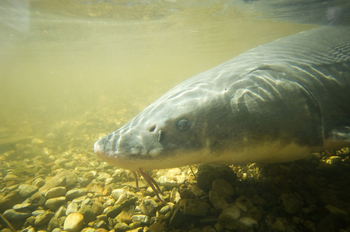 Lake sturgeon (Acipenser fulvescens), the only sturgeon species found in the Great Lakes, are unique in appearance and characteristics. They have five rows of bony plates, called scutes, on their backs and sides, as well as whisker-like barbels near their mouths. Lake sturgeon (Acipenser fulvescens), the only sturgeon species found in the Great Lakes, are unique in appearance and characteristics. They have five rows of bony plates, called scutes, on their backs and sides, as well as whisker-like barbels near their mouths.
Often referred to as “living fossils” or “dinosaur fish,” lake sturgeon first appeared in the fossil record in the Mesozoic Era, 100 million to 150 million years ago. These fish are long-lived, with some documented at more than 100 years old. Lake sturgeon are freshwater fish native to Michigan and found in North America throughout the Great Lakes, Mississippi and Hudson River basins. In addition to having high ecological significance, the species is an important cultural resource in our region. Due to overfishing and habitat loss and degradation, however, lake sturgeon abundance remains low throughout most of its historical range. read more – https://content.govdelivery.com/accounts/MIDNR/bulletins/3de8e62 |