Great Lakes Acoustic Telemetry Observation System network

We all know fish swim and move. But the when, where and why often remains a mystery for anglers and fisheries managers alike. 

Managing fish populations requires a comprehensive understanding of fish behavior ­– driven by the biology of the fish and the environments they live in ­– as well as the anglers who value and enjoy Michigan’s world-class fisheries. Understanding angler behavior is relatively easy because people talk and can tell us what they like to catch and what motivates them to fish.  Fish behavior, on the other hand? Well, that is more of a challenge. 

The animals we are passionate about, both as anglers and resource managers, aren’t vocal and remain hidden in the depths of Michigan’s waters, where their movements are mostly unseen.  Fortunately, fisheries managers in Michigan have adopted an advanced technology to unravel the mysteries of when, where, why and even how far fish travel. That technology is acoustic telemetry, and the information gained from this high-tech tracking method is helping fisheries managers address a variety of challenges, including conserving native stocks, controlling invasive species and understanding habitat use. 

Great Lakes Acoustic Telemetry Observation System network

acoustic receiver anchored underwaterDeciphering fish movement patterns in the Great Lakes with acoustic telemetry became much easier in 2010, with the creation of the Great Lakes Acoustic Telemetry Observations System. The GLATOS network uses cutting-edge technology to repeatedly observe the location of individual fish across short time intervals.

The ability to record the location of an individual fish over time is a substantial advancement from previous methods that solely relied upon knowing the release location of a uniquely marked fish and a subsequent recapture location, often provided by an angler. While the data from these methods are informative, a major shortcoming is that they provide no information on how the fish behaves between the time it was released and recaptured.

So how does acoustic telemetry work? The GLATOS network functions as a surveillance grid, consisting of receivers, or “listening stations,” strategically placed throughout the Great Lakes and capable of recording detections of fish that have been implanted with individually coded acoustic transmitters – or “pingers” – that the receivers are constantly listening for. This network of receivers and pinging fish provides vast spatial coverage of some of the largest lakes in the world and is supported by intensive collaborations among several state, federal and tribal fisheries resources agencies, universities and nongovernmental organizations.

There are currently more than 3,000 receivers in the Great Lakes Basin in the process of detecting pinging fish. An astonishing 24,000 fish have been implanted with acoustic transmitters since the GLATOS network was created, providing fisheries managers with year-round, 24/7, fine-scale fish behavior data that was never available before. 

Read on for a snapshot of what biologists have learned about some of Michigan’s most popular fish species, starting in Lake Michigan and taking a clockwise trip around The Mitten.   

Lake Michigan whitefish

DNR biologist implanting acoustic transmitter into fishLake whitefish yields in Lake Michigan and Lake Huron have declined by more than 50% since the early 2000s. Although the reasons for these declines remain somewhat unclear, the lasting effects of invasive species on Great Lakes habitat and food webs are certainly at play. For example, the smothering of rocky spawning reefs by invasive zebra and quagga mussels may be reducing lake whitefish egg deposition and survival.

As part of an effort to ultimately restore this lost reef habitat, researchers from the Michigan Department of Natural Resources and other agencies are using acoustic telemetry to characterize fine-scale movement patterns of lake whitefish on several reefs in northern Lake Michigan during the fall spawning season. Many acoustic receivers are placed closely together over the spawning reefs to precisely determine the position of acoustic-tagged fish and their spawning locations. Pairing these positional data with high-resolution maps of the water depths and lake bottom around the reefs allows researchers to examine the habitat characteristics that concentrate lake whitefish during the spawning season.

These data indicate that shallow reef complexes have “hot spots” for spawning activity that often correspond with shallow, low-sloping, rocky ridges. The collection of eggs on these hot spots has affirmed that acoustic telemetry data can be used to correctly identify spawning locations where egg deposition is occurring. Researchers are now using these high-resolution data to prioritize experimental invasive mussel removal efforts on spawning reefs to locally increase egg deposition and survival.

Saginaw Bay walleye

An acoustic transmitter being implanted into a walleyeDecades-long jaw tagging experiments have shown that some walleye leave Saginaw Bay for the main basin of Lake Huron, but before the GLATOS network was available, little was known about the actual proportion, timing and range of their movement. Acoustic telemetry led to the discovery that nearly 40% of Saginaw Bay’s walleye migrate into the main basin by June 1 each year, with no movement out of the bay later in the year. The fish that leave Saginaw Bay travel long distances and repeatedly go to the same destinations each year before returning in the fall to overwinter and spawn again the following spring.

Researchers aren’t sure why some walleye migrate and others remain residents of the bay, but whichever behavior they exhibit is consistent each year. These details about fish movement are very important for stock assessment and for setting fishing regulations, because they help managers understand when and where fish will be susceptible to angler harvest. 

More recently, acoustic telemetry is being used to learn where walleye are spawning in Saginaw Bay and how these spawning fish use the different rivers and reefs in the bay.  This work will help fisheries managers know which spawning locations are the most important to protect and perhaps pursue improvements to fish passage in rivers or restore reef habitat.

Muskie and smallmouth bass in the Lake St. Clair-Detroit River system

DNR fisheries research technician prepares to release an acoustically tagged muskellungeThe muskellunge and smallmouth bass fisheries in Lake St. Clair and its connecting waters are world-famous and renowned for their high catch rates. The Michigan DNR and its partners have been using the GLATOS network to better understand the behavior of these two species that are the target of substantial angler effort in southeast Michigan. 

Acoustic telemetry revealed widespread movements of muskie throughout Lake St. Clair, the Detroit River and Lake Erie, including the movement of one fish from its tagging location in the Detroit River all the way to Buffalo, New York, and back!  Movements like this demonstrate the potential connectivity of Great Lakes muskellunge populations, the movement potential of individual fish, and the importance of collaborative and well-coordinated interagency fisheries management for populations that cross state and provincial borders. 

Meanwhile, investigations of smallmouth bass in Lake St. Clair demonstrate that they tend to remain in relatively confined areas within the lake, like Anchor Bay in the northern part of the lake or the Mile roads on the western shoreline, despite frequent movements within those areas. This behavior suggests that the Lake St. Clair smallmouth bass population could be comprised of different subpopulations of fish, which may have their own demographics. The characteristics of these unique subpopulations must be accounted for when managing the lake as a whole.

Can anglers assist with acoustic telemetry research?

Yes! Anglers can and do provide a great deal of help with ongoing acoustic telemetry studies in the Great Lakes. Many of the fish that are currently pinging have external tags on their bodies that indicate an acoustic transmitter is implanted inside. When anglers catch one of these fish, they should call the phone number on the external tag or visit the Michigan DNR Eyes in the Field online reporting system to tell us, making sure to record the details on the external tag, including the tag number, prior to reporting. If the fish is harvested, the DNR can make arrangements to collect the acoustic transmitter, which can sometimes be reused in another fish. When a fish with an acoustic tag is captured by an angler and released, reporting the capture location helps biologists to confirm the fish is alive and verify its location.

If you’re interested in learning more about fish and the places they go, be sure to visit the GLATOS website for a variety of news articles and scientific publications highlighting the results of this important work throughout the Great Lakes Basin.

Check out previous Showcasing the DNR stories in our archive at Michigan.gov/DNRStories. To subscribe to upcoming Showcasing articles, sign up for free email delivery at Michigan.gov/DNREmail.


Note to editors: Contact: John Pepin, Showcasing the DNR series editor, 906-226-1352. Accompanying photos and a text-only version of this story are available below for download. Caption information follows. Credit Michigan Department of Natural Resources, unless otherwise noted.

Bass: A smallmouth bass with a freshly implanted acoustic transmitter and external anchor tag, extending from the fish’s stomach.

Implanting: Michigan Department of Natural Resources fisheries research biologist Jan-Michael Hessenauer surgically implants an acoustic transmitter into a smallmouth bass.

Muskellunge: Michigan Department of Natural Resources fisheries research technician Brad Utrup prepares to release an acoustically tagged muskellunge on Lake St. Clair.

Receiver: An acoustic receiver anchored underwater. More than 3,000 receivers in the Great Lakes Basin are currently in the process of detecting signals from fish implanted with individually coded acoustic transmitters. (Photo credit: T. Binder, Great Lakes Fishery Commission via GLATOS)

Transmitter: An acoustic transmitter being implanted into a walleye. After the transmitter is implanted, the body cavity is surgically sutured prior to releasing the fish into the water. 

Lake Erie “The Walleye Capital of the World”

Lake Erie anglers can expect the 2024 fishing

season to again offer world- renowned opportunities, according to the DNR.Lake Erie Charter fishing trip aboard The Stray Cat

Following years of strong walleye hatches, Lake Erie

continues to affirm that it is The Walleye Capital of the

World. Additionally, a stable yellow perch population in Lake Erie’s west zone will provide good fishing in 2024,  “Lake Erie is known worldwide as a top fishing destination for a variety of species,” said Travis Hartman, Lake Erie Fisheries Program Administrator for the Division of Wildlife.

The walleye daily limit on Lake Erie is six fish per angler with a 15-inch minimum length requirement.

Lake Erie walleye charter Monroe MI

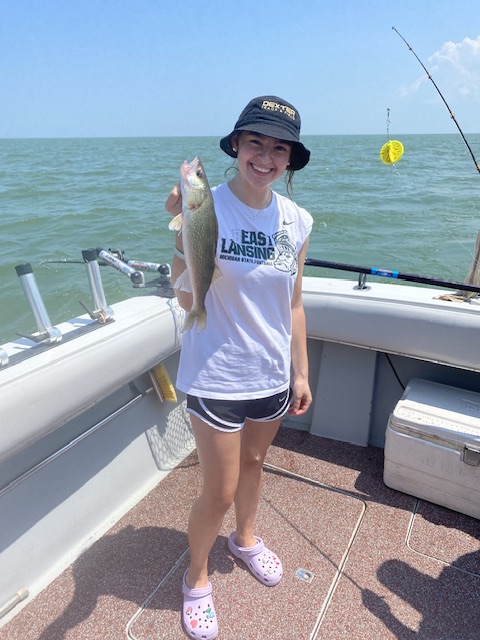
Walleye fishing aboard The Stray Cat

Walleye hatch success has been well above average for six consecutive years, including the three largest hatches ever surveyed.

Anglers will mostly catch abundant 2- to 6-year-old-fish ranging from 15 to 24 inches.

“The ‘23 walleye hatch showed above-average results in the western and central basins,” said Hartman.

“We expect walleye anglers to find outstanding fishing across the lake.”

From experienced to beginner, Detroit is a great place to fish

Detroit is known for many things. Shaping the modern auto industry. The birth of Motown music. Diehard fans rooting on their Lions, Pistons, Red Wings and Tigers.

Ranked the No. 5 fishing city in the country.  Detroit is home to some of the most diverse and plentiful fisheries in the country, including walleye, bass, perch, crappie, northern pike, channel catfish and muskie.

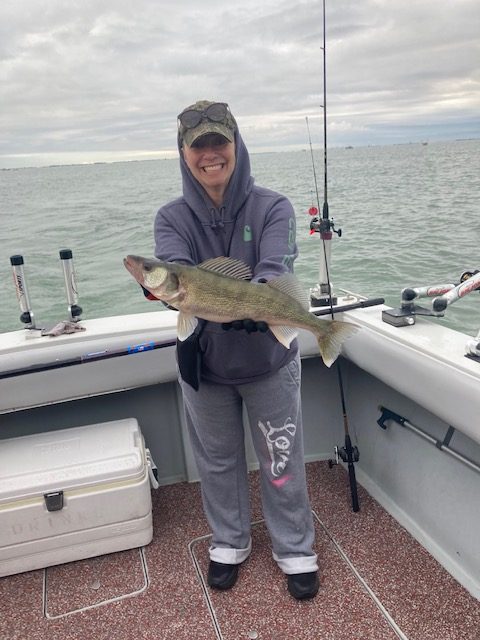
Cathrine Lake Erie Walleye aboard the Stray Cat

Walleye fishing trip Stray Cat Fishing Charter

Last year, licenses purchased by anglers and hunters generated over $66 million for the Michigan Game and Fish Protection Fund. The fund is the DNR’s largest revenue source and is critical to its conservation work. Fishing and hunting equipment sales raised an additional $32 million to support wildlife and natural resource management.

read more

Lake Erie Committee Sets Yellow Perch and Walleye Allowable Catches for 2022

Ann Arbor, MI— Lake Erie fishery managers from Michigan, New York, Ohio, Ontario and
Pennsylvania—meeting as the binational Lake Erie Committee (LEC)—agreed to a total
allowable catch (TAC) for 2022 of 14.533 million walleye and 7.185 million pounds of yellow
perch. Walleye are allocated by number of fish and yellow perch are allocated in pounds.
These TACs represent an increase in walleye from 12.284 million fish last year and an
increase for yellow perch from 6.238 million pounds of fish. Specific allocations of both
species are presented below by jurisdiction.
The LEC makes TAC decisions by consensus of the members. The LEC’s TAC
recommendations are produced after extensive, lakewide biological assessments, analyses,
discussions, and consultations with stakeholders. The recommendations are consistent with the
status of Lake Erie’s fish populations, taking into the account the goal of stable harvest. The
individual state and provincial governments implement the TACs in their jurisdiction in
accordance with their respective regulations and management objectives.

Stray Cat fishing charter

WALLEYE: Guided by the Walleye Management Plan, which was developed in consultation
with the Lake Erie Percid Management Advisory Group (LEPMAG), the LEC set a 2022
lakewide walleye TAC of 14.533 million fish, an 18% increase over the 2021 TAC of 12.284
million fish. The increased TAC reflects continued strong recruitment and high population
levels over the last several years. The Province of Ontario and the states of Ohio and Michigan
share the TAC based on a formula of walleye habitat within each jurisdiction in the western
and central basins of the lake. Under the 2022 TAC, Ohio will be entitled to 7.428 million fish,
Ontario 6.258 million fish, and Michigan 0.847 million fish. Jurisdictions in eastern Lake Erie
are outside of the TAC area, but harvest limits are set consistent with lakewide objectives.

YELLOW PERCH: The yellow perch fishery is divided into four management units (MU), which
generally correspond to the western, west-central, east-central, and eastern basins of Lake Erie. The
LEC has strived to maintain sustainable harvest while responding to changing abundance. The
proposed TAC represents differences among the management units in abundance and biomass.
Guided by the Yellow Perch Management Plan (YPMP), the LEC has finalized TAC decisions
for each management unit as follows: The TAC in MU 1 will increase to 3.038 million

Perch Fishing Charter Lake Erie

pounds. The TAC in MU 2 will decrease to 0.537 million pounds. The TAC in MU 3 will
increase to 3.082 million pounds. The TAC in MU 4 will increase to 0.528 million pounds.
In making these recommendations, the LEC relied on the YPMP, which was also developed in
consultation with the LEPMAG, and provided the technical foundation for the LEC’s
decisions. The plan established harvest policies aimed at maintaining population and fishery
sustainability for each MU using a stakeholder driven process. Each harvest policy was
extensively evaluated using simulation modeling with data inputs from fishery-dependent and
fishery-independent sources. The YPMP was designed to ensure fishery sustainability and
quality to satisfy conservation and maintain socio-economic benefits.

2022 WIll be another great Walleye season

COLUMBUS, Ohio – Lake Erie anglers can expect world-class walleye fishing opportunities to continue during the 2022 fishing season following years of strong hatches, according to the Ohio Department of Natural Resources (ODNR) Division of Wildlife. Lake Erie maintains its title as The Walleye Capital of the World thanks to science-based management guiding regulations that conserve and ensure long-term angling opportunities across Ohio’s waters.

Additionally, a strong yellow perch population in Lake Erie’s west zone will provide good fishing in 2022, while low catch rates are expected to continue in the central and east zones.

Lake Erie walleye and yellow perch fisheries are managed through an interagency quota system. Each jurisdiction regulates its catches to comply with annually determined safe harvest levels that ensure sustainability. The most recent quotas were announced on Friday, March 25.

Walleye

The walleye daily limit on Lake Erie is six fish per angler with a 15-inch minimum length limit. Walleye hatch success has been exceptional for six of the past eight years. Anglers will mostly catch abundant 2- to 4-year-old-fish ranging from 15 to 22 inches. Larger fish from 2015 and earlier hatches will provide chances to reel in a Fish Ohio qualifying walleye (minimum 28 inches).

Abundant young fish will show up in the catch and range from 9 to 14 inches, with an increasing number of 2-year-olds reaching 15 inches as the season progresses. Anglers are encouraged to release these sub-legal fish with as little handling as possible so they can contribute to the future fishery.

The Stray Cat Charter Boat

The Stray Cat

Yellow perch

Yellow perch abundance in the west zone from Toledo to Huron was above average in 2021 and is expected to remain strong in 2022, supported by consistent hatch success. The 2021 season occasionally provided good fishing in the west zone and should again in 2022. The best success is anticipated during July through mid-August during warm-water periods, and again during mid-October through November as adult perch move to shallow water to feed.

Lake Erie’s central zone from Huron to Fairport Harbor continues to experience low yellow perch abundance, primarily driven by poor to moderate hatches during the past decade. Conservative quotas continue to be set each year. In the east zone from Fairport Harbor to Conneaut, catches have been similar to the central zone with a slightly larger adult population. Catch rates are expected to remain low during the 2022 season, except for times such as late fall when adult perch congregate in larger schools near harbors.

Perch Fishing Charter Lake Erie

Yellow perch daily limits for each zone remain as described in the 2022-23 fishing regulations until May 1, 2022. Any adjustments in daily limits will be announced at wildohio.gov and on an insert printed for Ohio’s fishing regulations brochure before May 1.

Lake Erie fishing reports, information on Lake Erie research and management programs, fisheries resources, maps, and links to other Lake Erie web resources are available at wildohio.gov. The current fishing regulations can be found on the HuntFish OH app, at wildohio.gov, or locations where fishing licenses are sold.

The mission of the Division of Wildlife is to conserve and improve fish and wildlife resources and their habitats for sustainable use and appreciation by all. Visit wildohio.gov to find out more.

ODNR ensures a balance between wise use and protection of our natural resources for the benefit of all. Visit the ODNR website at ohiodnr.gov

Walleye Fishing Report Lake Erie Michigan 05-20-2021

Fishing picked back up around #1 buoy most are using bandits but I switched over to disc’s and spoons. Out front of Luna Pier was good until the Maumee dumped a bunch of debris from East winds right in the fishing grounds and turned the water muddy. The water has been mixing around the MI dump there were some stained water lines to fish along but after one pass the water would remix and the fish wouldn’t bite on the second pass. C buoy to Bolles seemed to have cleaner water but the fish were scattered if you put your time in, a nice grade of walleye can be caught. A slow troll 1.8 mph seemed to be the ticket. The surface temperature was 61.8 today Walleye fishing on Lake Erie

Fishing Report Lake Erie Monroe Michigan 07-03-2020

Walleye fishing on the Western Basin has been very productive during the Mayfly hatch especially early morning and late afternoon. Best bets are off Stoney Point near the restriction buoys at Fermi in 22 to 24 ft. of water. Either side on #1 buoy for about a mile and a half all the way back towards Bolles Harbor into 17 feet of water. The “Swamp” near Turtle Island to Luna Pier in 15′ to 17′ of water produced early mornings. I’ve used spoons with mini disc’s and wiggle warts both run from 70′ to 80′ back – color didn’t seem to matter. High divers at 42′ to 45′ and low divers 32′ to 36′. Jr. Silver Streak spoon – Cat-Dog  seemed the best on my low diver. Lots of short walleye this week, be patient the keepers will come. It’s a good thing for our future.

Walleye fishing Lake Erie

Walleye fishing Lake Erie

Please be courteous to fellow trollers and drifters we are all out to have fun and catch some walleye. Remember the U.S.C.G. “rules of the road” state if you are being approached by another vessel from your port side you the “right of way”. If you are being approached from your starboard side you “must give way” to the approaching vessel.  If your board gets run over it’s probably an accident  no need to come unglued at the offending fisherman. Have fun Be safe  

Fishing Report Lake Erie Monroe Michigan 06-10-2020

Walleye fishing off Stoney Point near the Michigan Ohio boarder, many limit catches using spoons and divers 70 to 90 back,

Lake erie walleye fishing charter

Walleye fishing charter Lake Erie

spoon color didn’t matter. Bandits produced well 70 to 90 back. E buoy  and the Michigan dump always has walleyes on it but they seemed to slow up a bit this past week. Limit catches are still being taken on Bandits 60 to 70 back on a mixture of colors. Spoons and disks produced well but are taking more shorts.

Lake Erie walleye numbers in stratosphere, future is bright

“The totals are astonishing,” said Hale. “We had high numbers in the 1980s, but we’ve made adjustments to our methods of counting walleye numbers, and believe this year’s population one the best we’ve seen.

“We have estimated today’s population of walleye that are two years old, or older, is about 116 million,” said Hale. “Our forecast for 2021 is a walleye population of 151 million.”

“The largest year-class in our present population is the 2018 class, which makes up about 75 percent of the population,” said Hale. “Anglers will be catching lots of walleye that are under the 15-inch size limit this summer, but those walleye will be legal to keep in 2021.”

2020 outlook read more


Walleye Fishing Report Lake Erie Michigan 07-25-2019

Lake Erie walleye fishing report

Walleye fishing is still good in the Western Basin. We had a real slow day Monday morning due to a cold front and a storm Sunday night. Fishing picked right back up on Monday afternoon. I’m still fishing wiggle warts on one side 60 to 80 ft. back, seemed anything with a red bill was out producing ones with out. The other side I’m running mini discs 70 ft. back with Silver Streak Jr.s  color didn’t seem to matter, I believe it’s the larger profile. High divers set at 3 42 to 46 back and low divers set at 1 32 to 35 back. My speed varies from 2.2 knots to 2.4 knots quartering into the wind seemed to produce better. 

Stoney Point seemed to have a good number of catchable walleye in 22 to 24 ft of water with no weeds. The Water Intake in 22ft water was a producer to. Seemed E Buoy area really slowed as with over the Michigan dump, the area around Turtle Island slowed but still holds fish. Around the contours just in front of the Edison plant is holding fish to.

Walleye fishing Lake Erie, Stray Cat Charter Fishing

Walleye fishing Lake Erie aboard the Stray Cat

As with all things be kind to your fellow trollers. Don’t sit with your back to the helm staring at your rods, that’s what your buddies are for, it’s a good way to piss off other trollers. I ran over someone’s gear who was not paying attention and approaching from my port side and I’m the bad guy? Remember a boat approaching from your starboard has the right of way